If you’ve had a panic attack before, you already know what it feels like. Your heart starts racing, your chest tightens, and for a few minutes your brain is completely convinced something is seriously wrong. You might feel a sudden need to escape the room, or a sense that your body is somehow betraying you.
When panic attacks keep happening, the fear of the next one can start shrinking your world. You turn down invitations, avoid crowded places, feel uneasy being alone. Living with panic disorder is exhausting, but you don’t have to carry it by yourself.
Through online counseling sessions, I help clients understand what their nervous system is actually doing and give them practical tools to get their footing back.
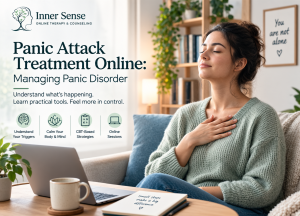
Key Takeaways
- A panic attack is your body’s alarm system going off at the wrong moment. It feels frightening, but it is temporary and not dangerous.
- The fear of the next attack is often what keeps panic disorder going, and that cycle can be broken.
- CBT, mindfulness and somatic regulation tools give you practical ways to calm your body and change worst-case thinking.
- Online counseling lets you practice these tools in the exact space where your anxiety usually shows up.
What’s Actually Happening During a Panic Attack?
A panic attack is your body’s alarm system going off at the wrong time. Your brain misreads stress, or even a physical sensation, as a threat, even while you’re sitting safely at your desk, and releases a surge of adrenaline. That triggers fight-or-flight.
Your heart rate spikes to send blood to your muscles faster. Your breathing gets shallow, which can cause lightheadedness, chest tightness, or tingling fingers. Your muscles tense up as your body braces itself.
These sensations are intense, but they’re not dangerous. Recognizing that a panic attack is a temporary alarm, not an actual emergency, is usually the first real step toward taking its power away. (For more on how stress shows up physically and what helps, see our guide on managing stress with CBT and mindfulness.)
Why Online Counseling for Panic Disorder?
People often ask whether online sessions can really help with something as intense as panic disorder. In practice, working online has some real advantages for anxiety in particular.
- You start from a place you already feel safe: your own living room or a quiet corner of your house, instead of an unfamiliar office.
- We practice where it matters: grounding and regulation techniques are tested in the exact environment where your anxiety usually shows up.
- No added stress: you skip the drive, the traffic and the transit before or after a session that’s meant to calm you down.
Video counseling gives us a calm space to look at your specific triggers and build your confidence that your body can settle back down.
Not sure what a first video session feels like? Read what to expect from your first online CBT session. And if you’re managing anxiety while living outside your home country, you might also find our piece on therapy for expats useful.
CBT Methods and Regulation Tools
I draw on cognitive behavioral methods along with mindfulness and somatic regulation to help clients break the panic cycle. Instead of treating panic as one big, unbeatable thing, we break it into pieces we can actually work with.
Changing the thought loops. Panic runs on thought loops: “What if I faint?” “What if I lose control?” Using CBT, we look closely at these automatic thoughts, notice where your mind jumps to worst-case scenarios, and practice reframing them into something steadier and more realistic.
Calming the body. Because panic shows up so strongly in the body, thinking your way out isn’t always enough. We work on specific breathing patterns, long, slow exhales, along with grounding techniques that tell your nervous system you’re safe, so your heart rate and chest tightness can ease.
Making peace with the sensations. A big part of panic disorder is becoming afraid of the sensations themselves, a flutter in your chest, a moment of dizziness. In sessions, we work on shifting how you interpret those signals so they stop being an automatic trigger for panic.
Taking the First Step
Panic can make your life feel small, but it doesn’t have to stay that way. Reaching out is a reasonable thing to do, you don’t need to wait until you’re in crisis to ask for help.
If you’re ready to explore how online counseling can help with panic disorder, feel free to reach out to learn more or schedule an initial consultation. You can also read about my approach and session policies first.
FAQ
Is online counseling actually effective for panic attacks?
Yes. CBT and somatic regulation techniques work the same way over video as they do in person, and being in your own space can make grounding exercises easier to practice, since it’s the environment where anxiety actually shows up.
How many sessions does it usually take to see a difference?
This varies by person, but many clients notice some shift in how they relate to their symptoms within the first several sessions, with continued progress as coping tools become more automatic.
What if I have a panic attack during a session?
That’s completely fine, and it’s actually useful, we can work through grounding techniques together in real time, while it’s happening.
Do I need to already understand CBT to start?
No. We build everything from where you’re at. You don’t need any background in therapy or psychology to begin.
Is this different from in-person panic disorder treatment?
The core approach is the same: CBT, mindfulness, and somatic tools. The main difference is convenience and comfort: no commute, no waiting room, and you’re practicing techniques in the space where you’ll actually need them.